What makes digital production successful today can be boiled down to three key themes: data security and data sovereignty, compliance, and operational control. Companies that consider these three dimensions in isolation create patchwork systems instead of well-structured solutions. Those who integrate them create the foundation for a production environment that operates reliably and can adapt to new requirements.
The IT Reality in Manufacturing Companies
The will to digitize exists in most companies. However, the reality often looks quite different. IT landscapes have evolved organically over time, rather than being strategically planned. Isolated legacy systems exist alongside a multitude of SaaS applications, without any meaningful integration. Data is scattered in silos, is inconsistent, and is difficult to use for operational decisions.
As a result, IT security, governance, and compliance become ongoing tasks rather than clearly controlled processes. Current market analyses confirm that these are widespread, structural problems affecting companies across all industries and of all sizes. The cause is usually not a lack of technology, but rather a lack of integration, unclear responsibilities, and high change management costs.
Low-code remains a key success factor, even in the age of AI.
A common assumption is that AI-powered coding assistants and autonomous agents will render low-code platforms obsolete in the medium term. Leading market researchers have reached a different conclusion. Low-code platforms remain a central component of modern software development, precisely because they can be directly combined with AI capabilities. For technology managers, the question is no longer whether, but how both approaches can work together effectively. Intrexx pursues precisely this approach: human and machine intelligence are combined in such a way that technology supports people, rather than replacing them.
Data Builder: Integrated, consistent, controllable.
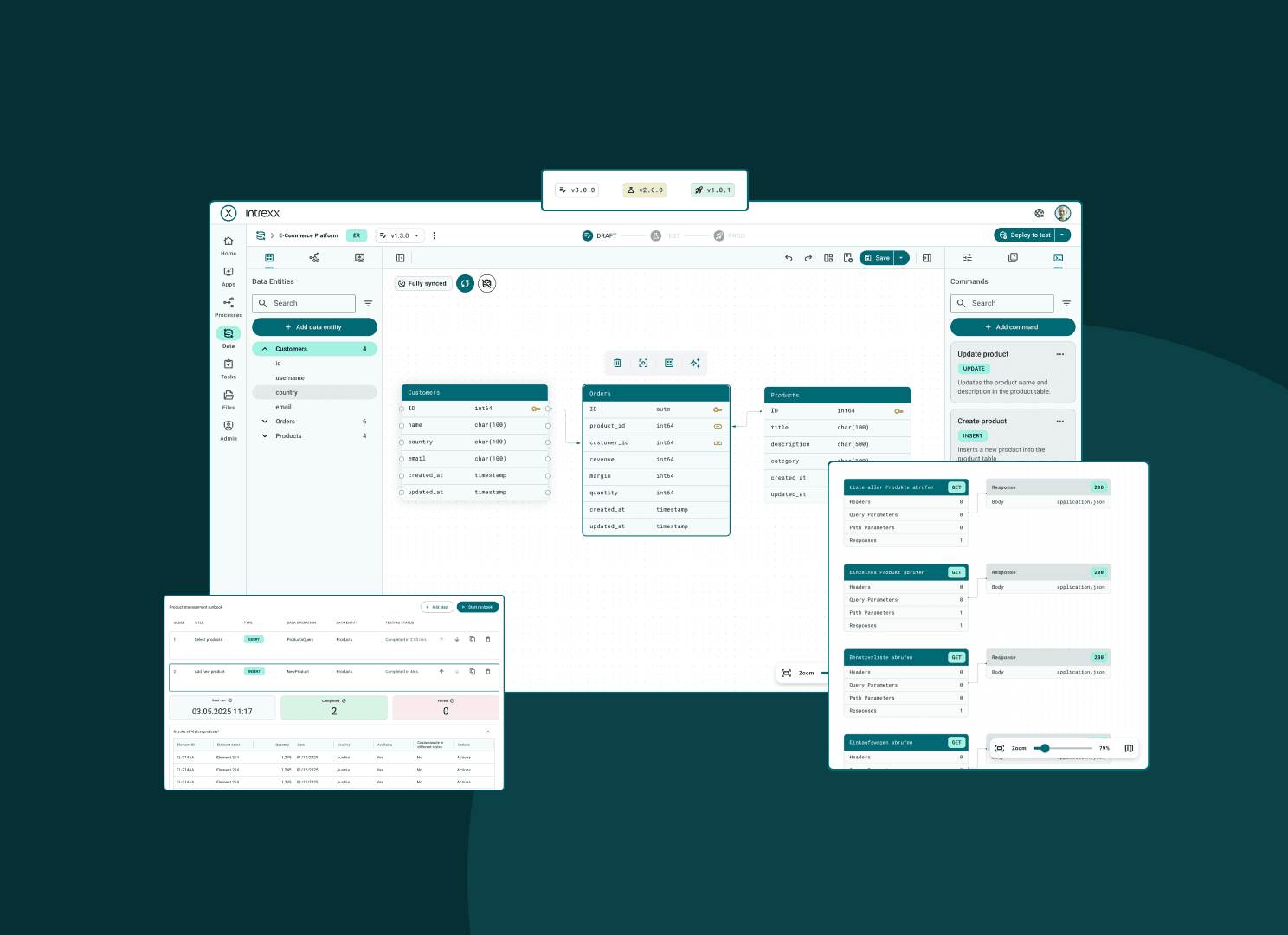
The Data Builder forms the foundation of the platform. SQL databases and REST web services can be directly connected and centrally managed without proprietary adapters or manual intermediaries. Existing system landscapes can be integrated with just a few clicks via reverse engineering. Recurring data operations such as migrations, validations, and interface tests can be defined, automated, and versioned as runbooks, ensuring they remain traceable and reproducible at all times. The result is a consistent, duplicate-free database with transparent control over all data flows within the company.
Process Builder: Modeled according to BPMN, controlled in real time.
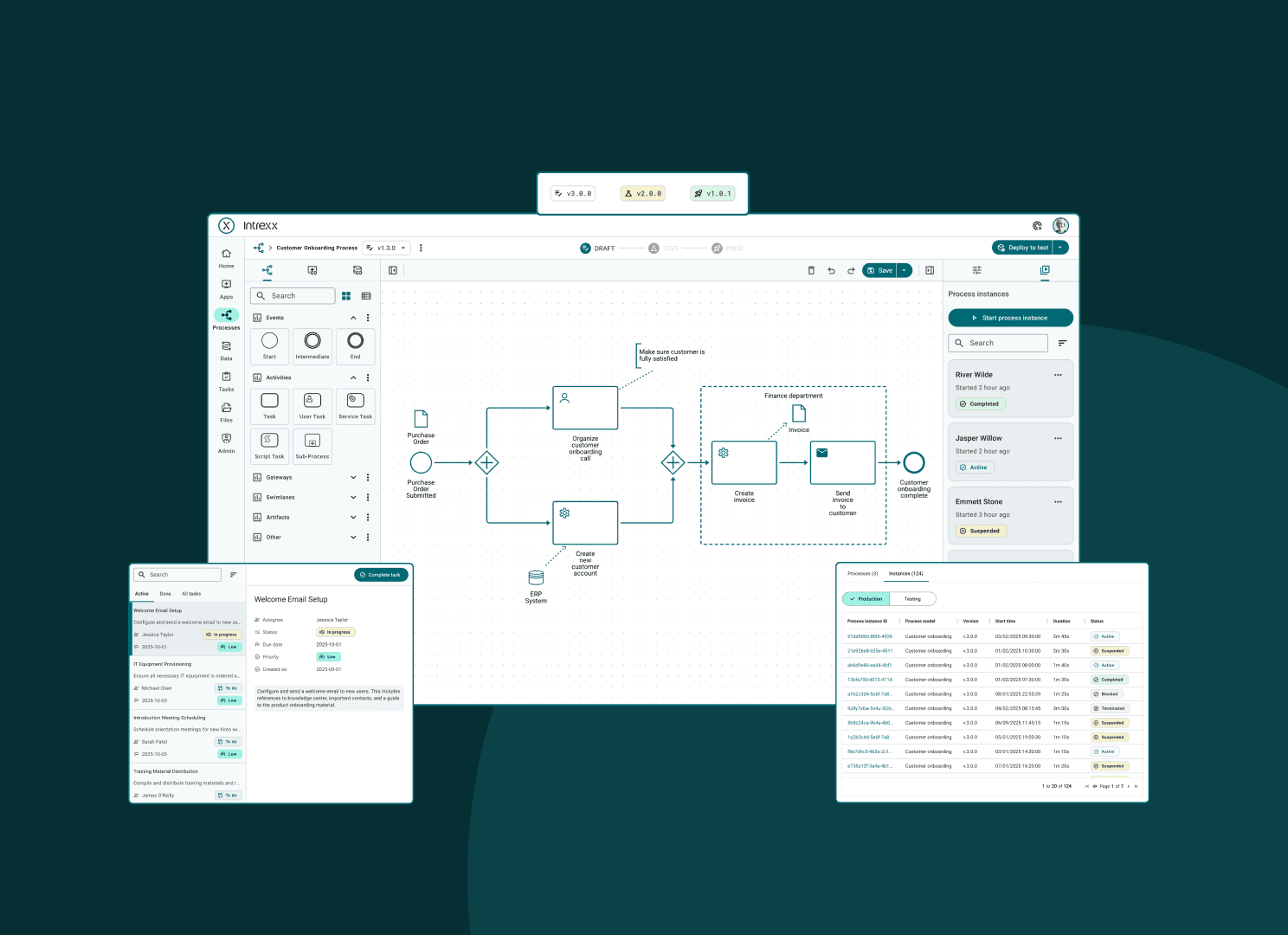
Business processes are modeled according to the BPMN standard and automated by an integrated process engine. Tasks can be assigned and communicated directly to the responsible individuals. Ongoing processes can be continuously tracked and monitored. Transparency and traceability are therefore not optional additions, but integral components of every process from the outset.
App Builder: Visually developed, centrally managed.
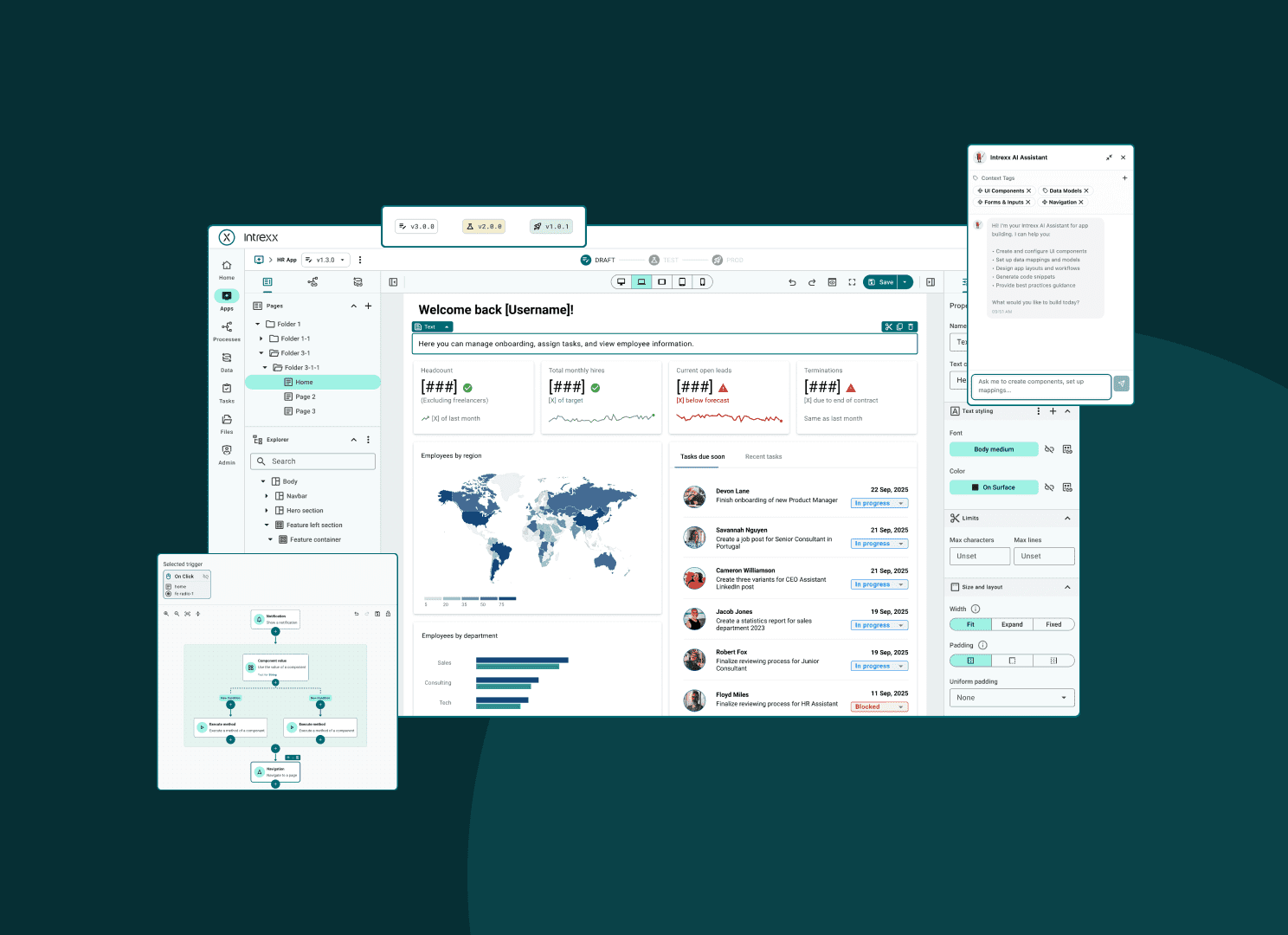
Action flows enable applications to be designed visually and adapted flexibly without losing sight of the business processes. A central design system ensures that changes to the corporate identity are automatically applied to all applications. The integrated AI assistant helps developers create applications faster. Instructions in natural language are translated into functional results.
Scalable step by step.
Digital production cannot be modernized with a single project. A crucial approach is one that considers existing structures, reduces complexity, and creates demonstrably significant added value incrementally. Intrexx recommends a structured, four-phase approach: First, the platform is connected to existing data sources. Building on this, modern business applications with intuitive user guidance are developed. In the third step, AI and cloud services are added to functionally extend applications. Finally, end-to-end processes are fully automated, and outdated systems are gradually replaced.
Companies that consistently follow this path are not creating a short-term solution, but rather an infrastructure that grows with the company's needs.